Alignment was happening in hallway conversations
Before Compass, execution status for cross-functional initiatives lived in whichever tool each team happened to prefer: a Jira board here, a spreadsheet there, a Slack thread nobody could find again. Brand, Digital, and operations partners were each making decisions from a different picture of "where things stood."
Leadership had identified the cost of that misalignment but not the shape of a fix. That's where I came in, not with a solution already in hand, but with a mandate to go find out what was actually happening on the ground.
Discovery before design
I ran a discovery phase across the teams feeding into Compass, mapping how work actually moved through intake, prioritization, and execution, rather than how the org chart said it should. That meant sitting in on planning meetings, shadowing handoffs between teams, and asking people to walk me through the last time a project slipped.
Trade Operations, Marketing, and Digital all surfaced the same root problem independently, without ever comparing notes. In Operations, 37 TPMs were manually creating 23,000+ promotional events in offline Excel planners, routed through four separate approval loops with manual email handoffs at nearly every step. In Marketing, two analytics teams, media performance and campaign/volume, were tracking the same initiatives without ever sharing a single view. Nobody said "we need better data." They said, independently, that the data existed but never told one whole story.
— synthesized from discovery interviews across Trade Operations, Marketing, and Digital, 2025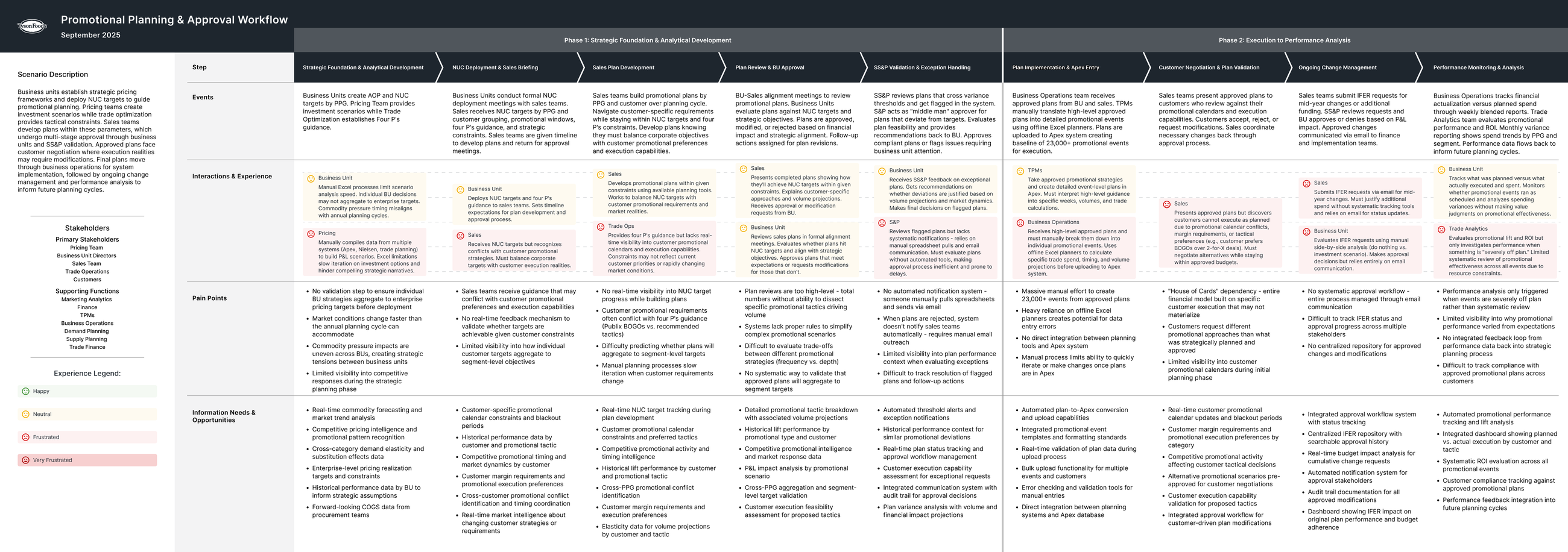
I translated those findings into a business case leadership could act on: not "the tools are fragmented," but a clear picture of where time and cost were actually being lost, and what closing those gaps was worth. That framing, backed by industry benchmarks like McKinsey's finding that 59% of trade promotions lose money, is what got Compass greenlit as the company's #1 priority product for FY26.
One shared view, built for the handoff moment
The design goal followed directly from the research: Compass needed to make the handoff between teams the easiest part of the process, not the weakest link. I designed around a single shared view of status that every team could read the same way, with enough depth underneath for the specifics each team actually needed.
Simple by default
The default view answers one question, "what's blocked and who owns it," with nothing else competing for attention.
Complex made possible
Power users (ops leads managing dozens of initiatives) can drill into dependency chains and history without that complexity leaking into the default view.
Shared vocabulary
Status labels were workshopped with every team that would use them, so "blocked" means the same thing in Brand as it does in Ops.
Governance built in
I documented intake and status-update standards alongside the UI, so the system stays consistent as more teams adopt it.
Click through the prototype that shaped what shipped
This is the Figma prototype I used to test the pricing flow with real users before writing a line of code, fully interactive, not just static frames. It isn't what's live today, but it's what directly shaped the direction the production build took.
From prototype to production
The prototype above is what let us test the pricing flow with real users before writing a line of code. It shaped the direction the product took. This is what's actually live in the application today, built and shipped by me on top of that validated design.
Product name and internal user identity are redacted throughout. The underlying pricing and volume data is real, live production data, not placeholder content.
Inside the piece that turned 6 days into 5 minutes
The pricing optimizer is the core of Compass: the specific workflow that replaced the old six-day, multi-team email-and-Excel process for assembling a promotional pricing plan. Here's what that flow actually looks like now.
Picks a product, then a retailer
The flow starts with a single required field: the product. Once it's selected, a control bar opens for retailer, strategy goal (max revenue, max profit, minimum spend), and timeframe. From there, a detailed scenario editor sets the real constraints: margin targets, shelf-price bounds, and how many promo weeks are allowed and how close together.
The system won't run a broken plan
There's no separate step where Compass flags a conflict after the fact. It's built into the constraints themselves. Required fields block the run until they're complete, and hard rules like maximum concurrent promotions, forbidden weeks, and price floors are baked into the solve itself. The optimizer can't recommend a plan that breaks them.
Optimizer recommends the plan, week by week
Once it runs, Compass returns a full pricing waterfall (shelf price broken down from list price to promo price), plus a week-by-week table of recommended pricing, expected volume, and trade spend for the entire plan, not just a single number.
Plans route for approval automatically
Submitting a plan sends it into an automatic approval workflow instead of an email chain, routed based on which business group it belongs to. TPMs can see exactly which approval step a plan is sitting at and how long it's been there, instead of following up manually to find out.
Designed and shipped by the same hands
I built the front end myself, extending the enterprise design system I lead directly rather than working around it. When a component didn't exist yet, I built it into the system myself instead of filing a request and waiting on someone else's roadmap. Owning research, design, the system, and the build meant fewer handoff losses of my own: a layout constraint discovered in code could get resolved the same afternoon, not in next sprint's design review.
I actively write code and push directly to our dev environment, eliminating the design-to-dev handoff entirely. No waiting on a developer to interpret a Figma file or file a ticket for a spacing fix. What I design, I ship.
Where it landed
Time to assemble a full pricing plan, down from six full working days of back-and-forth email and manual Excel editing to under five minutes.
Priority ranking across every active product initiative at the company, in FY26.
Previously siloed teams, Trade Operations, Marketing, and Digital, each independently surfaced the same fragmentation problem, validating Compass as the shared fix.
Compass also optimizes trade spend allocation directly, surfacing not just whether a promotion is scheduled, but whether it's happening at the right time, closing a gap where teams were previously flying blind on both timing and spend efficiency.
What I'd do differently
If I started Compass again, I'd bring engineering into the discovery interviews earlier, not just to socialize findings after the fact, but so technical constraints could shape the research questions themselves. It's the same principle as the design: the earlier the handoff happens, the less gets lost in it.